When Pushing Too Hard Becomes the Obstacle: Rethinking Effort and Performance in Fighting


When Forcing Becomes the Obstacle: Rethinking Effort and Performance in Combat
Do you remember that fight where nothing was working? You had prepared your techniques, drilled your combinations hundreds of times, studied your opponent, visualized every scenario. And yet, on the tatami, the harder you pushed, the more you stiffened. The more you wanted to perform well, the later your strikes landed, off target, without bite. Every additional effort you piled on seemed to push the very thing you were chasing further away. You walked off the tatami exhausted, frustrated, carrying that nagging feeling that you hadn't tried hard enough, that next time you'd have to work even harder.
That belief gets drilled into us from every direction. Work harder. Push further. Grit your teeth. Success belongs to those who suffer more. And in the world of Kyokushin karate, where the ethic of effort is sacred, where the word "Osu" itself evokes endurance and perseverance, the equation between pain and result seems self-evident. You bleed and sweat in the dojo, you absorb the low kicks that grind your thighs round after round, you throw hundreds of mawashi (circular kicks) on the bag, and you end up convinced that this quantity of effort is what will make you unbeatable in combat.
Except that's not what I see, after fifty-five years on the tatami.
The illusion of effort as the engine of performance
Here's what decades of observation have taught me: the quality of your performance in combat does not follow the quantity of effort you deploy. It follows the quality of your inner state in the moment. It's that simple, and that unsettling.
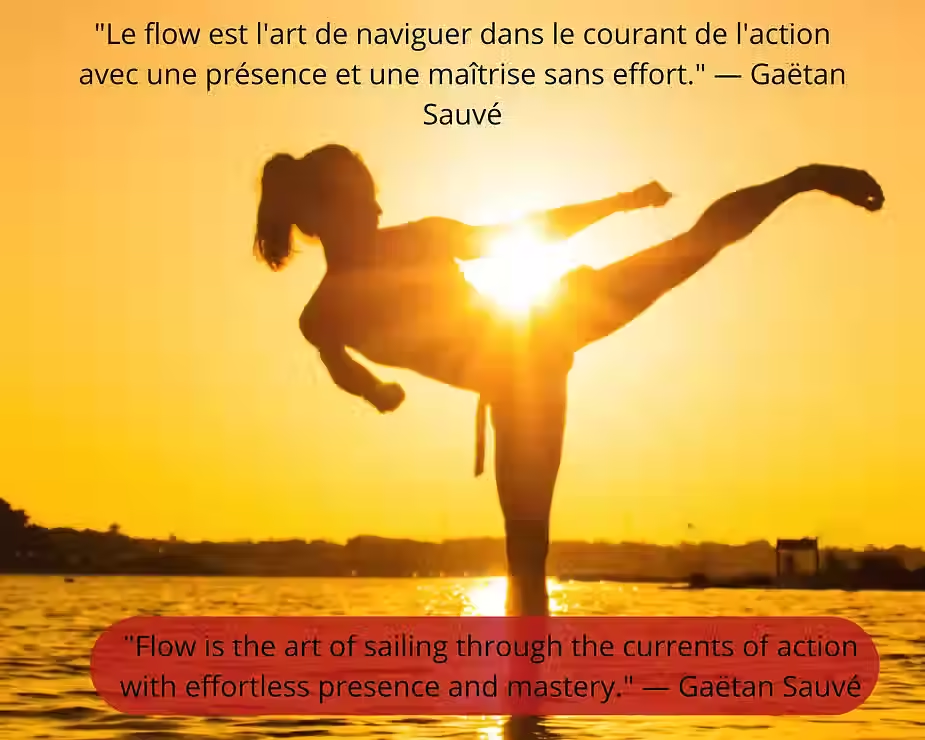
When you step onto the tatami with a clear mind, a settled breath, an available consciousness, your karate expresses itself almost without apparent effort. Your feet find the right angles without you thinking about it. Your low kick fires at the right instant, not because you decided to throw it, but because the opening revealed itself to your perception and your body answered. You see series of openings simultaneously, you chain low kick, body punch, knee, finishing move, and all of it arrives like a wave unfolding. You're not doing karate. Karate is happening through you.
And when you step onto the tatami with a cluttered head, shallow breath, personal thinking commenting on every movement like a panicked consultant, your performance collapses, no matter how many hours you logged on the bag the previous week. Your techniques are there, your conditioning is there, your experience is there, but they become inaccessible. The interference is too loud. The noise drowns out the living intelligence.
This is exactly what I explore in my latest book on Flow in combat: performance rises and falls with inner clarity, not with the volume of effort. And when we push harder to compensate for a troubled inner state, we only add pressure, noise, and tension. We dig deeper in the wrong direction.
Why forcing turns against you in combat
Think about what physically happens when you force. Your shoulders rise. Your breath locks in your chest. Your vision narrows into a tunnel on what you believe is the target. Your hara loses its anchor. Your muscles engage against each other instead of working together. Your reaction time stretches because the noise of personal thinking covers over direct perception, and the gesture that should have emerged spontaneously has to wait for something slower — conscious decision — to take its place.
Excessive effort creates exactly the opposite conditions of what you need to fight in Flow. Knockdown combat demands wide peripheral vision, available breath dropping into the belly, muscular release coupled with total vigilance, perception that naturally filters out noise and catches the anomalies in your opponent's posture (all markers of Flow that I discuss in the second part of my book). All of this shuts down the moment you push. All of this opens the moment you settle.
This isn't poetic metaphor. It's an observable physiological reality, round after round. The fighters who dominate in knockdown are almost never the ones who look the most clenched. They're the ones who appear strangely available, almost relaxed, despite the brutal intensity of the exchange. Their effort is there, but it's channeled, generated from a stable center, not projected from scattered tension.
Where performance actually comes from
Notice that your best ideas often come in the shower, or during a walk, and almost never in the moment when you're pushing hardest on a problem. What you're searching for arrives when the mind settles, not when you crush it under the weight of will.
The same is true in the dojo. The truest strikes you've ever thrown in your life as a fighter, the ones that came out like lightning, the ones that crossed your opponent's guard without you knowing how, the ones where you felt it wasn't you acting but something acting through you — those strikes never came from extra effort. They came from a moment of total availability, from a shift (insight) where thinking went quiet and living intelligence took over.
This doesn't mean training doesn't matter. Of course it matters. You have to build the technical repertoire. You have to condition the body. You have to polish the fundamentals for years. But that training is what makes your body available for Flow. It's not the effort of fighting that produces performance — it's the inner availability that lets emerge what training has already deposited in you.
The real question to ask before combat
Next time you're preparing for an intense kumite, a competition, or a grading, observe what's happening inside you. Are you pushing? Are you telling yourself that you absolutely have to win, that you absolutely have to do better than last time, that you absolutely have to prove something? All that pile-up of "have to" — that's personal thinking dressed up as motivation. It's noise mistaking itself for strength.
The real question isn't: "How can I try harder?" The real question is: "What's the quality of my inner state right now?" If the mind is clear, the body will follow. If consciousness is available, the techniques will emerge. If the breath drops, living intention will take its place. Everything else — strategy, power, precision — organizes itself around that.
You don't need to add anything to your preparation. You need to remove what obstructs. You don't need more willpower. You need less interference. You don't need to force Flow to appear. You need to stop preventing it.
That's the complete reversal offered by the Generative Fighter approach, which naturally moves from the inside out. Your performance doesn't come from the effort you stack on the surface. It comes from the clarity that appears when the stream of thought settles and your karate becomes once again the direct expression of living intelligence.
The most powerful fight you'll ever wage will have nothing to do with the quantity of effort you deployed. It will have everything to do with the inner state from which you stepped onto the tatami.
Gaétan Sauvé, Kyokushin Karate practitioner since 1971
Author of: Flow in Combat – The Generative Fighter. Available on Flowcombat.ca


Comments